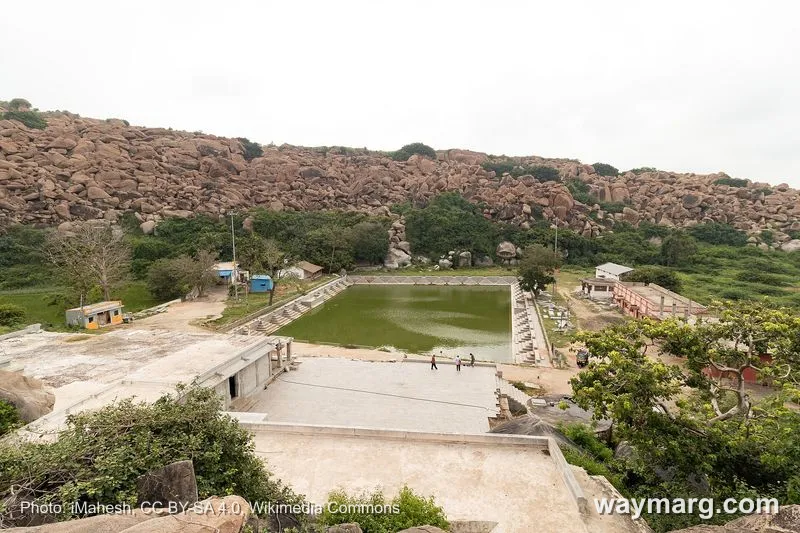
Pampa Sarovar, Hampi: The Lake Where Rama Met Sabari
Shabari was old by the time Rama finally reached her. The Ramayana says she had been waiting at sage Matanga's ashram, on the forested hill above this lake, for years — maybe decades — on nothing more than the sage's promise, given before he died, that Rama himself would one day walk into her hermitage. She had spent that time gathering berries from the forest, tasting each one first and discarding anything sour, so that only the sweetest would be ready whenever he arrived. Everyone around her had long since stopped believing he would come. When Rama and Lakshmana finally did appear, in the middle of the search for Sita, Shabari offered what she had: half-eaten fruit, pre-tasted by a woman most of her society would have dismissed as low-born and unworthy of serving anyone, let alone a prince. Rama ate it anyway, and by every major telling of the story, ate it with visible warmth rather than courtesy — the one detail that turns Shabari's episode into one of the most quietly radical moments in the entire epic, a devotion the text treats as outranking rank itself. Soon after, by tradition, Shabari gave up her body at this exact spot, on the banks of what is now called Pampa Sarovar.
The lake carries an older layer of myth too, independent of Rama. In the Shaiva tradition, Pampa is one of the names of Parvati, and this lake is where she is said to have performed severe penance to win Shiva as her husband — the name "Hampi" itself is widely held to be a corruption of "Pampa," and the presiding deity of Hampi's great Virupaksha temple a few kilometres away is still worshipped alongside the Pampa-Virupaksha pairing that gives the whole site its sacred name. Walk the lake today and you're standing at the point where two entirely separate devotional stories — Shabari's patient, lifelong faith and Parvati's penance for a god — were layered onto the same water centuries apart.
- State: Karnataka, Koppal district (Hampi / Anegundi)
- Key legend: Shabari's half-eaten berries; Parvati's penance as Pampa
- Best months: November–February
- Minimum time: 1–1.5 hours
- Suitable for: Pairing with Matanga Parvata (1 km away) and Anegundi's Anjanadri Hill
Where the Kishkindha Chapter Begins
Pampa Sarovar sits roughly a kilometre from the base of the hill tradition identifies as Matanga's ashram — meaning Shabari's long wait and Rama's arrival happened, in the story, almost within sight of this water. It's also the point where the Ramayana's search narrative turns from wandering grief into strategy: Shabari is said to have pointed Rama toward Sugriva, the exiled monkey prince hiding nearby, telling him that an alliance with the vanara kingdom was his best path to finding Sita. From here the epic moves into the whole Kishkindha arc — Hanuman's first meeting with Rama, Sugriva's war with his brother Vali, and the eventual search parties sent out across the subcontinent — all of it traditionally rooted in this same stretch of boulder-strewn land around Hampi and Anegundi.
A Lake, Not a Monument
Unlike Malyavanta or Matanga Parvata, Pampa Sarovar has no single dominant shrine built around its central legend — it's a natural lake, roughly a kilometre long, with lotuses on the water for much of the year and a scatter of small, still-functioning temples around its edge: a Lakshmi shrine and a Shiva shrine face the pond directly, and a modest Ganesh shrine stands beside it under a mango tree, used by local pilgrims rather than kept as a tourist stop. The setting is quieter and less built-up than Hampi's major temple complexes, which is part of its appeal — it still reads as the kind of forest-and-water hermitage landscape the Ramayana describes, rather than a monument retrofitted onto the story.
Visiting Today
Pampa Sarovar is open-air and unticketed, with no fixed gate hours — most visitors come in the early morning or late afternoon, both for the light and to avoid the midday heat, which is intense from March through May. The small lakeside shrines are active, so modest dress is appropriate, and this is a working devotional site rather than a staffed monument — don't expect signage, a ticket counter, or a guide stationed on-site. Bring water; there's little shade directly at the lake, though the walk in passes banana plantations and farmland that offer some relief.
When to Go
November through February brings the mildest weather for the walk in and the best light on the water. The lake is at its most photogenic when the lotuses are in bloom, generally through the cooler months; by the height of summer the water level can drop noticeably. There's no single named festival tied specifically to Pampa Sarovar, but it sees heavier local footfall during Hampi Utsav (usually held in November) and around Ugadi, when pilgrims combine a visit here with Virupaksha temple a short drive away.
Getting There
Pampa Sarovar lies on the Anegundi side of the Tungabhadra, roughly 5–6 km from Hampi Bazaar and about 18–20 km from Hospet, the nearest railhead and the usual base for buses and taxis into the Hampi area. Most visitors reach it by auto-rickshaw or scooter from Hampi Bazaar via the Anegundi road, or combine it on foot with Matanga Parvata, which rises just beside it. It also sits a short ride from Anegundi village and Anjanadri Hill, the site tradition names as Hanuman's birthplace — together these points form a natural half-day loop through the heart of mythic Kishkindha before or after seeing Hampi's Vijayanagara-era ruins proper.
Ready to plan your trip?
Build a day-by-day itinerary with WayMarg — explore routes, nearby food and stays, collaborate with family, and export your trip. No sign-up needed.
Plan My Trip →