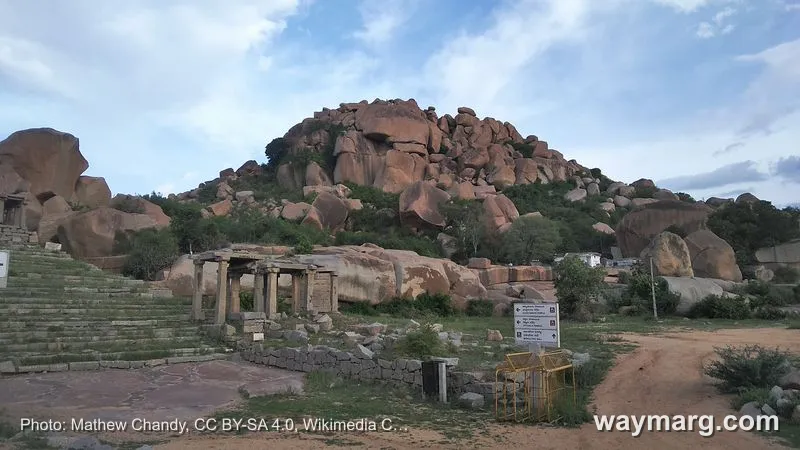
Matanga Parvata, Hampi: Where Sugriva Hid from Vali
Vali and Sugriva were brothers, and for most of the Ramayana's Kishkindha chapter they were also mortal enemies. Vali, the elder, ruled the vanara (monkey) kingdom of Kishkindha from its capital; Sugriva, believing his brother had died fighting a demon inside a cave and fearing the demon would next come for him, sealed the cave's entrance and took the throne in his place. When Vali returned alive, he didn't ask for an explanation — he assumed betrayal, exiled Sugriva, and took his brother's wife as his own, an act the epic treats as the deepest possible violation between kin. Sugriva fled to the one place Vali's power couldn't reach: Matanga Parvata, the hill named for the sage Matanga, whose ashram here was protected by a curse. Matanga had sworn that Vali would die instantly if he ever set foot on the hill, and Vali — for all his rage — never tested it. For years, Sugriva lived on this summit in genuine fear, watching the kingdom he'd ruled from a hill he couldn't leave.
It's here, by tradition, that Rama and Lakshmana climbed to meet him during the search for Sita — guided by Hanuman, who had been sent to assess whether the two exiled princes were a threat or an opportunity. The alliance struck on this hill is the hinge of the entire Kishkindha arc: Rama agreed to kill Vali and restore Sugriva to the throne; Sugriva, in turn, committed the full vanara army — including Hanuman himself — to the search for Sita, without which the Ramayana's path to Lanka doesn't exist. Matanga Parvata is, in that sense, not a footnote to the epic but the place where its entire second half gets decided.
- State: Karnataka (Hampi) — the highest point in the Hampi ruins
- Key legend: Sugriva's refuge, protected by sage Matanga's curse on Vali; the alliance struck here with Rama
- Best time of day: Sunrise — widely rated Hampi's best sunrise point
- Climb: 35–45 minutes, moderate to difficult in its upper boulder section
- Suitable for: Pilgrims and general Hampi visitors alike
The Hike Itself
Matanga Parvata is Hampi's highest point, and the climb reflects it. The lower stretch, from the Hampi Bazaar side near Achyutaraya Temple, is a defined stone path; the upper third turns into a scramble over large, loose boulders where a misstep has real consequences — more than one visitor account describes the descent as the harder half, needing careful footing rather than speed. Reasonable footwear matters here more than at most Hampi sites; flip-flops are a bad idea. Budget 35–45 minutes up at a steady pace, longer if you're stopping for the view along the way, and bring a headlamp or phone torch if you're climbing in the dark for sunrise.
Hampi's Best Sunrise
The summit opens onto a 360-degree view across Hampi's entire boulder landscape — the Tungabhadra on one side, the temple spires of Hampi Bazaar and Virupaksha on another, and an unbroken field of granite boulders stretching toward the horizon in every direction. It's consistently rated among the best sunrise spots in Hampi, and unlike the sunset crowds at the Royal Enclosure, the summit at dawn tends to draw a smaller, quieter group — climbers who've made the deliberate choice to be up before light. There's a small tea stall near the top catering to that early crowd; prices for visitors tend to run higher than in the bazaar below, so don't expect bazaar rates at 6 AM on a hilltop.
Two Layers of History, One Hill
Matanga Parvata rises inside the same site most visitors come to Hampi for an entirely different reason: the 14th–16th century ruins of the Vijayanagara Empire, which built its capital directly around and among these same hills, centuries after the Ramayana's traditional setting. The hill carries both stories in the same ground without either one erasing the other — worth knowing rather than reconciling, since they're separate timelines occupying identical geography.
Visiting Today
The hill is unticketed and open from before dawn to after dusk, though climbing after dark without a clear plan isn't advisable given the terrain. There's no formal entry gate — the trailhead is a short walk from Hampi Bazaar, past Achyutaraya Temple. Carry water; there's no reliable shade on the upper slopes, and the exposed granite heats up fast once the sun is up. Monkeys are common on the way up and will take unattended food.
When to Go
November through February is by far the most comfortable window — cooler mornings make the pre-dawn climb far more pleasant, and visibility at sunrise tends to be best in winter before the pre-monsoon haze sets in from March. Avoid the climb altogether during the hottest stretch of April–May, when the exposed boulder section becomes genuinely risky at midday heat.
Getting There
The main trailhead sits a 10–15 minute walk from Hampi Bazaar, making this the easiest of the three Kishkindha hills to combine with a Hampi Bazaar stay. It's about a kilometre from Pampa Sarovar, letting you pair the sunrise climb with a visit to the lake on the walk back down, and roughly 18–20 km from Hospet, the nearest major town and rail link. Most visitors treat this hill as the anchor of a single Kishkindha-themed morning, adding Malyavanta Raghunatha later in the day since it sits on a different, quieter side of the Hampi complex.
Ready to plan your trip?
Build a day-by-day itinerary with WayMarg — explore routes, nearby food and stays, collaborate with family, and export your trip. No sign-up needed.
Plan My Trip →