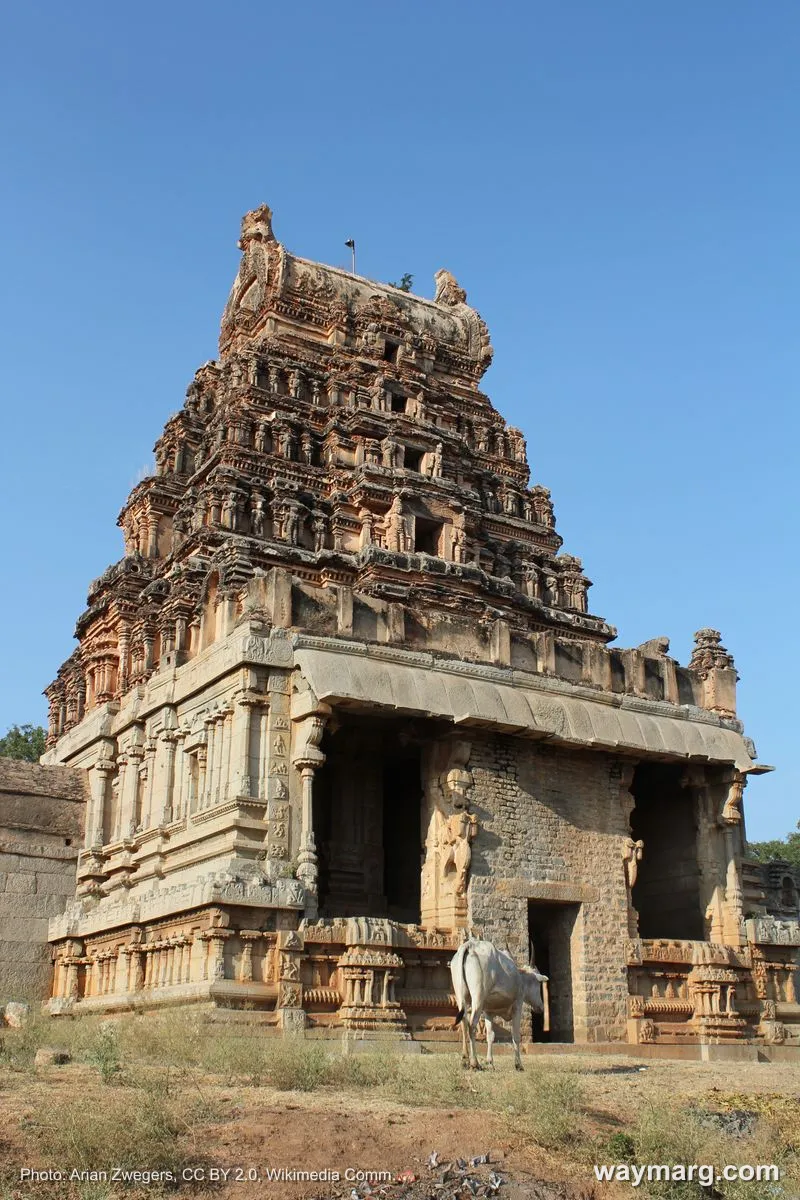
Malyavanta Raghunatha, Hampi: A Shrine Built Around the Boulder Rama Sheltered Under
By the time Rama and Lakshmana reached Malyavanta Hill, Vali was already dead and Sugriva was back on the throne of Kishkindha — but the campaign against Ravana hadn't actually started. Sugriva's army needed time to be summoned from across the vanara kingdoms, and the monsoon had arrived, making any march south impossible until the rains broke. So Rama waited. Tradition holds that he and Lakshmana spent this entire monsoon season sheltering on Malyavanta Hill, watching the rain move across the same boulder country visible from Matanga Parvata a few kilometres away, while word went out to assemble the vanara forces for the war to come. It's a quieter, less dramatic episode than Sabari's devotion or Sugriva's exile — a long pause before the Lanka campaign rather than a turning point in it — but it's the reason this exact hill carries Rama's name into its temple's own.
What makes Malyavanta distinctive isn't just the story but what later builders did with it. Rather than raising an ordinary temple nearby, Vijayanagara-era patrons built the main shrine directly around the boulder Rama is said to have sheltered beneath, carving bas-reliefs of Rama, Lakshmana, Sita, and Hanuman straight into its rock face. The boulder itself rises above the temple roofline like a natural shikhara, with a smaller, built votive shikhara placed on top of it — a genuine "rock temple," rare even within a site as thick with temples as Hampi.
- State: Karnataka (Hampi, "outer circuit")
- Key legend: Rama and Lakshmana's monsoon wait before the march on Lanka
- Built: Vijayanagara era (precise date undocumented — see note below); still an active, worshipped temple today
- Best months: November–February
- Minimum time: 45–60 minutes
A Temple Carved Into Living Rock
Beyond the central boulder shrine, the complex is a full Vijayanagara-period layout: a large south gopuram and a smaller east gopuram mark two entrances, leading into a mahamandapa (main pillared hall) and an ardhamandapa with its own entrance portico, all enclosed by a perimeter wall. A separate Devi shrine stands to one side of the main sanctum. Scattered across the surrounding bedrock, rows of lingas and Nandi figures are chiselled directly into the living rock rather than built as freestanding sculptures — a detail easy to miss on a fast visit and worth the extra ten minutes of looking.
Still a Living Temple
Unlike many of Hampi's monuments, which are preserved ruins rather than active places of worship, Raghunatha temple on Malyavanta Hill continues as a functioning shrine, with regular puja and local devotees visiting alongside history-minded travellers. That living status shapes how to behave here: this isn't a museum stop, and basic temple etiquette — modest dress, removing footwear at the threshold, quiet during any ongoing ritual — applies in a way it doesn't at Hampi's purely archaeological sites.
Visiting Today
The temple keeps no separate ticketed hours of its own and is generally open through daylight hours with a likely midday lull, in line with how most of Hampi's smaller active shrines operate; there's no ASI entry fee here the way there is at Hampi's ticketed monument zone (Vittala Temple and the Royal Enclosure). Modest dress is expected, and it's worth checking locally for puja timings if you want to see an active ritual rather than just the architecture.
When to Go
November through February brings the most comfortable weather for the walk up and the clearest light on the boulder carvings. Being on Hampi's quieter outer circuit, Malyavanta sees a fraction of the footfall of Virupaksha or Vittala even in peak season (December–January), which makes it a good counterbalance to a day spent in Hampi's busier core.
Getting There
Malyavanta Hill sits east of the Talarigatta–Kamalapur road, a short drive or auto-rickshaw ride from both Hampi Bazaar and Kamalapur, the two main bases for staying near the ruins. It's roughly 20–22 km from Hospet. There's no confirmed lodging directly at the site, so pair it as a half-day stop rather than a base — most visitors combine it with Matanga Parvata and Pampa Sarovar on the same Kishkindha-themed day, visiting Malyavanta either early, before the heat builds, or on the way back from the Hampi Bazaar side in the late afternoon.
Ready to plan your trip?
Build a day-by-day itinerary with WayMarg — explore routes, nearby food and stays, collaborate with family, and export your trip. No sign-up needed.
Plan My Trip →