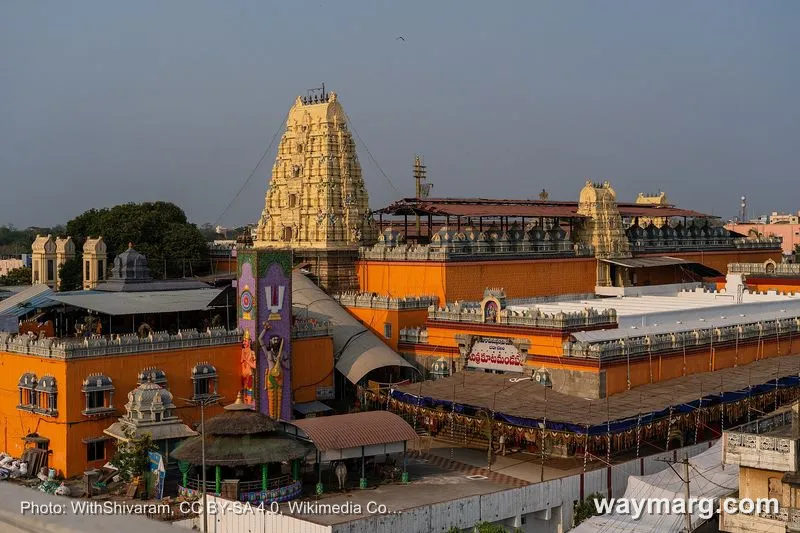
Bhadrachalam, Telangana: The Temple of the Four-Armed Rama
Bhadrachalam carries two stories that have nothing to do with each other and everything to do with why the temple looks and feels the way it does. One is set in the Treta Yuga, during Rama's forest exile, and explains why the main idol here has four arms instead of the usual two. The other is set almost four thousand years later, under a Muslim sultanate that taxed its Hindu subjects and imprisoned the official who diverted that tax money into rebuilding this temple -- and it explains almost everything else: the pearls sent every year at the wedding festival, the eight-faced wheel on the tower, even the saint's name most people in Telangana know the site by, Ramadasu, rather than its own.
- State: Telangana (Bhadradri Kothagudem district, on the Godavari)
- Official site: bhadradritemple.telangana.gov.in
- Best festival: Sri Rama Navami Brahmotsavam and the Sitarama Kalyanam, 12 days, March/April
- Minimum time: 1.5–2 hours
- Suitable for: One of the most actively visited Rama temples in India today
Bhadra's Penance, and a Promise Kept Late
During the fourteen years Rama, Sita, and Lakshmana spent in exile, they moved through the Dandaka forest along the Godavari, and tradition places part of that journey here. By Rama's grace, a stone on this hill is said to have become a devotee -- a man named Bhadra, described as a son of Mount Meru. The sage Narada came to him and taught him the Rama Taraka mantra, and Bhadra sat on the Godavari's bank chanting it, year after year, in the hope that Rama himself would one day appear before him. Rama, passing through on his way to confront Ravana, promised Bhadra that he would return and show himself once Sita was found and brought home.
He didn't keep that promise in his own lifetime. The epic's events ran their course -- Sita's rescue, Ravana's death, the return to Ayodhya, the long reign that followed -- and Bhadra's penance simply continued on its own timeline, unresolved. The temple's own telling holds that it was Vishnu, not Rama returning in person, who eventually appeared to Bhadra in Rama's form to make good on the old promise -- and that in the process of taking that form, Vishnu manifested with four arms rather than two, the extra pair presumably carrying symbols proper to Vishnu rather than the two-armed, bow-carrying Rama of the epic itself. That is the explanation the temple gives for why its central icon is shown four-armed, almost unique among Rama temples in India, and for why the hill -- and the town that grew around it -- took Bhadra's name: Bhadrachalam, Bhadra's hill.
Kancherla Gopanna: A Tax Officer, a Temple, and Twelve Years in Prison
The temple as it stands today -- its four entrances, the fifty steps up to the main gateway, the gold-plated flagpost -- is credited to a 17th-century revenue official named Kancherla Gopanna, remembered across Telugu-speaking India not by that name but by the title he earned: Bhadrachala Ramadasu, "Rama's servant of Bhadrachalam." He was born around 1620 in Nelakondapalli, in what's now Khammam district, and by most accounts reached his post in Bhadrachalam through family connections -- his maternal uncles, Akkanna and Madanna, held senior positions at the Golconda Sultanate's court in Hyderabad and arranged his appointment as tahsildar, the local revenue officer responsible for collecting land tax (and, under Golconda's rule, the jizya levied on non-Muslim subjects) across the Palvoncha region.
Gopanna was already a devout worshipper of Rama when a severe famine struck the area. Visiting what was then a far smaller, much older shrine to Rama on this hill, he resolved to rebuild it properly -- and did so using close to six lakh varahas, roughly six hundred thousand gold coins, drawn from the tax revenue under his control, without first getting permission from Golconda's court. He did not hide what he'd done. When the Sultanate's tax collectors came to audit the district's accounts under Abul Hasan Qutb Shah -- known popularly as Tana Shah, the last sultan of Golconda, who ruled from 1672 to 1686 -- the shortfall was immediately obvious, and Gopanna was arrested on charges of misappropriating public funds.
He spent twelve years in a Golconda prison, by most accounts in a cell in the fort itself, composing devotional songs to Rama throughout his confinement -- scholars who've catalogued his surviving compositions count roughly sixty of his best-known works, including much of the Dasarathi Satakam, as written during this imprisonment rather than before or after it. The terms of his release were unambiguous: the treasury had to be repaid in full, or he would be executed. Popular tradition -- the version told at the temple itself and in Telugu folk memory far more widely than any administrative record -- holds that Rama and Lakshmana appeared before Tana Shah in human form, repaid the debt in gold coins stamped with Rama's own image, and vanished, leaving the sultan convinced of what he'd witnessed and leaving Gopanna free. A closely related version has Tana Shah dreaming of Rama the night before the coins were found beside him. Either way, the outcome in the folk telling is the same: divine intervention, not state clemency, secured the release, and a sultan whose own faith lay elsewhere is remembered as the one who sent a yearly gift of pearls to the temple from that point on -- a custom that later Muslim rulers of the region, the Nizams of Hyderabad among them, are said to have continued, and one the temple still honors every year at its wedding festival.
Historians treat this as devotional legend rather than documented fact, and for good reason -- there's no administrative record of gold coins appearing in a sultan's treasury, and the religious framing of the story (a Muslim ruler humbled by a Hindu god) reads as exactly the kind of triumphant folk narrative communities build around real hardship. What the historical record does support is messier and, in its own way, just as striking: Gopanna's roughly twelve-year imprisonment would have run through much of the 1670s and into the 1680s, placing his release close to the end of Golconda's independent existence altogether -- Mughal forces under Aurangzeb besieged and took the Golconda fort in 1686-87, ending the Qutb Shahi dynasty for good only a short time after Tana Shah is said to have let Gopanna go. Whatever actually happened in that prison cell, it happened at the edge of the regime that held him. Gopanna died in Bhadrachalam in 1688, in his late sixties, having lived to see the temple he rebuilt outlast the court that jailed him for it.
Why the Name Persists
Telugu devotional music still calls Bhadrachalam's patron saint "Ramadasu" more often than it uses his birth name, and that's a direct legacy of this story -- a revenue official punished for an act of devotion, whose songs (traditionally numbered around 190, though a more conservative critical count puts his verified compositions closer to 130) are still sung as a distinct genre within Carnatic and Telugu devotional music. The composer Tyagaraja, writing a century later, dedicated several of his own compositions to Ramadasu by name, a rare case of one revered composer-saint explicitly honoring another. The eight-faced Sudarshana Chakra mounted on the temple's tower is said, in temple tradition, to be the very one Gopanna found in the Godavari while searching for materials -- one more detail the temple folds directly into his story rather than treating as separate history.
Visiting Today
Bhadrachalam runs one of the most tightly structured daily seva (ritual service) schedules of any actively used Rama temple in India, closer to the rhythm of a living pilgrimage town than a historical monument on a tourist circuit. The day opens with Suprabhata seva around 4 AM, moves through Balabhoga (morning food offerings, roughly 5:30–7 AM) and extended archana (prayer services) from 8:30–11:30 AM, closes for a midday break from noon to 3 PM, reopens for afternoon archana, and runs an evening Darbar seva from 7–8 PM before closing for the night following the Pavalimpu (literally "putting to sleep") ritual. Annadanam -- free food for visiting devotees -- is served daily at the Ambasatram on the temple's southern side, and is worth factoring into a visit if you're arriving around a mealtime. Modest, traditional dress is expected, and the temple is administered directly by the Telangana state government's endowments department, which has run it since 1958 -- a rarer level of direct official backing and documentation than most sites on this circuit have, with the temple's own portal publishing seva timings, festival dates, and accommodation options well ahead of time.
When to Go: The Sitarama Kalyanam
The single event that defines Bhadrachalam's calendar is the Sri Rama Navami Brahmotsavam, a twelve-day festival in March or April built around one ceremony: the Sitarama Thirukalyana Mahotsavam, the celestial wedding of Rama and Sita, performed on the eve of Rama Navami itself. It's timed precisely by Pancharatra Agama rules to the Punarvasu and Abhijit stars rather than to a fixed calendar date, and it draws devotees in numbers that make it, by most estimates, the single largest Rama Navami celebration held at any individual temple in India -- larger, proportionally, than the Rama Navami observances at far more famous sites, precisely because the wedding ceremony itself, not just the birthday, is the headline event here. The temple's own three-disc mangala sutra (wedding necklace) is used in the ceremony, and the pearls and silk sent each year in the tradition traced back to Tana Shah's court are presented as part of the rite. If you want to see Bhadrachalam at its fullest -- and its most crowded -- this is the window; arrive the day before and expect the town's normally modest infrastructure to be stretched well past capacity. Outside the festival, the temple's weekday mornings, particularly the window around the 8:30 AM archana before the midday closure, are the calmest time to visit.
Getting There
Bhadrachalam sits on the west bank of the Godavari in Bhadradri Kothagudem district, in Telangana's southeastern corner near the Andhra Pradesh border. Khammam, the nearest major town, is roughly 100 km away and the most common staging point for a visit. Hyderabad is about 300 km by road, generally a six-to-seven-hour drive; Vijayawada, on the Andhra Pradesh side, is somewhat closer at roughly 170 km. There's no airport in Bhadrachalam itself -- Rajahmundry and Vijayawada are the nearest airports with regular service, both requiring a further road journey. The site pairs naturally with Parnashala, roughly 35 km upriver along the Godavari and tied to the same stretch of Rama's exile narrative -- most visitors who make the trip out to Bhadrachalam combine the two into a single day.
Ready to plan your trip?
Build a day-by-day itinerary with WayMarg — explore routes, nearby food and stays, collaborate with family, and export your trip. No sign-up needed.
Plan My Trip →