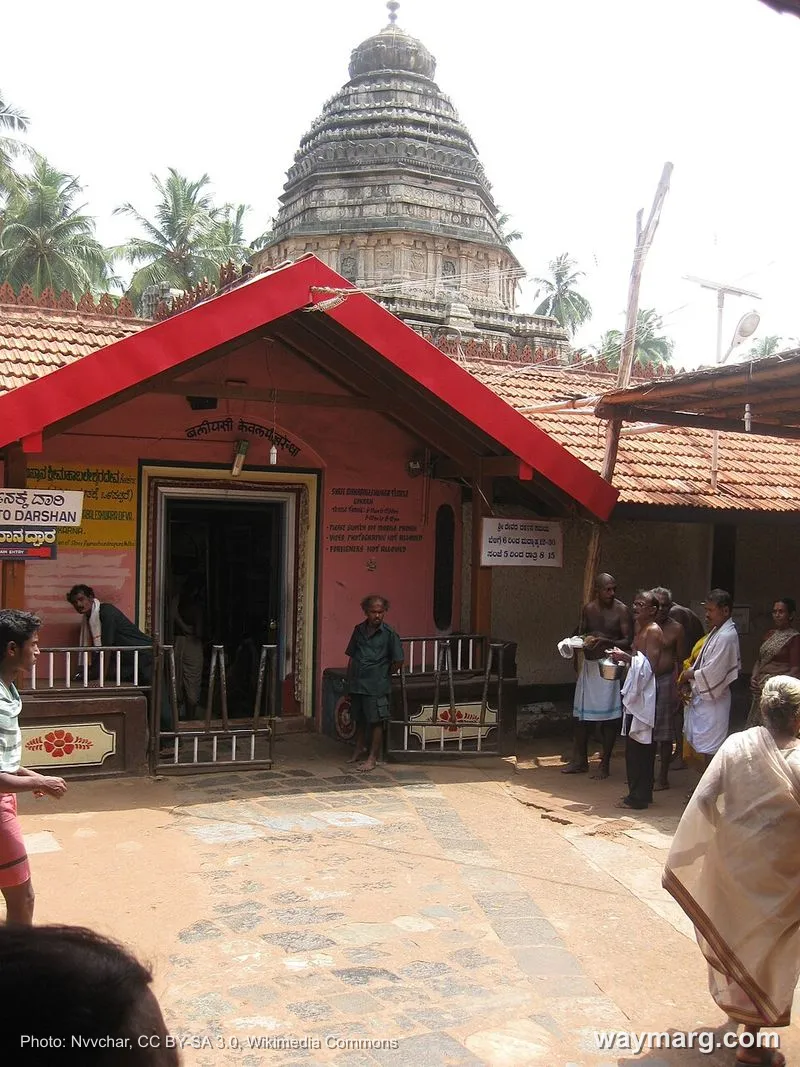
Gokarna Mahabaleshwar, Karnataka: The Atma Linga Ravana Could Not Move
Ravana, by his own telling the greatest devotee Shiva ever had, once climbed Kailasa and performed a penance so severe -- by some versions, offering his own heads one by one on a vina strung with his own nerves -- that Shiva finally relented and gave him the Atma Linga: not an ordinary stone carved and consecrated by priests, but a self-manifested form Shiva had worn as his own soul-image. Whoever possessed it, the stories agree, would command invincible power. Shiva gave it on one condition, almost an afterthought compared to the gift itself: the linga could never touch the ground before Ravana carried it home to Lanka. Set it down even once along the way, and it would root itself there forever.
That single condition terrified the gods. An invincible Ravana, settled safely in Lanka with the Atma Linga in his own shrine, was a threat none of them could undo. So as Ravana began his long journey south carrying the linga with both hands, Vishnu quietly darkened the sun over the Gokarna coastline, and the gods worked to delay him until evening. Pressed by the hour of his twilight rituals and needing both hands free, Ravana looked for anyone trustworthy enough to hold the linga for a few minutes. Ganesha appeared on the shore disguised as an ordinary herding boy and offered to help -- with one condition of his own: he would call out to Ravana three times, and if Ravana didn't return by the third call, he would set the linga down. Ravana agreed, not recognising the god standing in front of him, and went to bathe and pray. Ganesha called once, twice, a third time -- and when no answer came, he lowered the Atma Linga onto the sand at Gokarna. It fused into the earth instantly, immovable, as if it had always been rock.
Ravana returned to find the linga gone from his hands and set into the ground, and understood at once what had happened. In a fury, he tried to tear it free -- by some tellings using his bare strength, by others hurling his crown or driving his fist into the earth around it -- and only succeeded in ripping away pieces of the cloth and metal casing that had covered the linga during the journey. Those torn-off fragments flew from his hands and landed at four separate points along the coast: the cloth covering at Murudeshwar, the casket's cords at Dhareshwar, its lead seal at Gunavanteshwara, and its outer wrapping at Sajjeshwar, each piece becoming the seed of its own shrine. The linga itself stayed put, and Ravana, unable to move it, is said to have named the spot Mahabaleshwara -- "lord of great strength" -- as a backhanded tribute to the very power that had defeated him. The cow Ganesha had used to call out to Ravana is said to have also vanished into the earth nearby, leaving only an ear-shaped outcrop of rock on the shore -- which is why this town is called Gokarna, "cow's ear."
- State: Karnataka (Uttara Kannada district)
- Managed by: Shri Kshetra Mahabaleshwar Devasthan Trust (under a Supreme Court-appointed Overseeing Committee since 2021)
- Documented age: Core shrine linked to the 4th-century Kadamba king Mayuravarma; named in Kalidasa's 4th-century Raghuvamsha
- Best months: November–January; Maha Shivaratri (Feb/Mar) for festival crowds
- Minimum time: 1–1.5 hours
- Suitable for: The anchor stop of the Pancha Kshetra circuit; pairs with Gokarna's beaches
What the Legend Doesn't Explain: A Temple Older Than Most of Karnataka
Set the myth aside and the Mahabaleshwar Temple still has a genuinely old, datable history of its own -- which is rarer than it sounds for a Shiva temple whose founding story is purely legendary. Tradition and most temple accounts credit a structure here to the Kadamba king Mayuravarma in the 4th century CE, built around a linga already venerated at the site; the poet Kalidasa, writing in that same century, refers to the "Lord of Gokarna" in his epic Raghuvamsha, which is about as early and independent a literary confirmation as a Karnataka temple gets. The Tevaram -- the 6th-to-7th-century Tamil Shaiva canon -- lists Gokarna among its 275 paadal petra sthalams, sacred sites sung about by the Nayanar saints, putting this temple in the company of some of the subcontinent's oldest living Shiva shrines. Much of what you actually walk through today, though, including the bulk of the surrounding temple complex, is Vijayanagara-period work from roughly the 14th to 17th centuries -- meaning the sanctum's core and the buildings around it are separated by close to a thousand years of rebuilding, repair, and expansion, the way most very old Indian temples actually age rather than surviving untouched.
The World's Only Atma Linga
The temple trust itself describes this as the world's only Atma Linga of Shiva -- a claim rooted in the legend's uniqueness as much as the object's rarity. The sanctum's Saligrama Peetha is a square stone platform with a small central opening through which only the very top of the linga is visible year-round; it's deliberately kept half-buried and unseen, since legend holds that if it were ever fully exposed and the whole linga visible, Ravana's invincibility would pass to whoever looked on it. Full ritual exposure happens only during the Ashtabandhana Kumbhabhishekam -- a re-consecration using an eight-part binding paste that reseals the deity's base -- historically performed roughly once every forty years, a cycle temple accounts describe as necessary to the shrine's upkeep rather than merely ceremonial. Beyond that shared trait with the twelve Jyotirlingas and other swayambhu (self-manifested) lingas across India, Gokarna's own distinct touch is the three linked sacred sites tradition ties together here: the ear-shaped Gokarna rock formation on the shore, the atmalinga inside the sanctum, and the nearby Bhadrakali Temple.
What "Pancha Kshetra" Actually Means
Pancha Kshetra -- "five sacred fields" -- is the name pilgrimage tradition gives to this exact five-temple group: Gokarna and the four sites that received a fragment of the Atma Linga's casing when Ravana tore at it. The logic of visiting all five in sequence isn't simply "see five temples" -- it's that each site is held to carry a share of the same original consecration, so completing the circuit is treated as a single continuous act of devotion rather than five separate visits, the same reasoning behind other grouped pilgrimages like the Char Dham or the twelve Jyotirlingas. Gokarna, holding the linga itself rather than a fragment, is the natural first and last stop.
Visiting Today
Traditional attire is required for sanctum entry -- dhoti for men, saree or salwar/traditional dress for women; stitched trousers, jeans, and shorts aren't permitted past the inner gate, and rental dhotis are usually available near the entrance for travellers caught without one. Darshan generally runs through the morning and evening temple hours typical of major Karnataka shrines (roughly 6 AM to 1 PM and 4 PM to 8:30 PM, with some variation by season -- confirm the day's schedule at the entrance, since festival days shift it). Free prasadam is served to all devotees, alongside theertha and vibhuti after darshan. Use only the trust's own seva counters for any paid ritual booking -- unofficial individuals near the entrance sometimes offer paid "VIP darshan" or guide services that aren't sanctioned by the temple administration, a common scam at high-footfall Karnataka temples.
When to Go
Maha Shivaratri is by far the biggest night of the year here -- Gokarna's Shivaratri draws one of the largest single-night pilgrim gatherings on the Karnataka coast, with the town's narrow lanes and the temple's own car-street procession packed well past midnight; arrive a day early if you want an unhurried darshan, or embrace the crowd and the all-night atmosphere as part of the experience. Outside that week, November through January brings the most comfortable weather and the heaviest general tourist season because of Gokarna's beaches, so early mornings (before 9 AM) are the calmest window for darshan specifically. The monsoon months (June–September) are quiet at the temple but can make beach-combining plans difficult.
Getting There
Gokarna sits on the Uttara Kannada coast, roughly 55 km south of Karwar and reachable by the Konkan Railway (Gokarna Road station, about 8-9 km from town) or by road from Goa (around 140-150 km) and Mangaluru (around 230 km). As the anchor of the Pancha Kshetra circuit, it's the natural base: Dhareshwar lies roughly 25-30 km south near Kumta, Gunavanteshwara roughly 45-50 km further on near Honnavar, Murudeshwar another 20-25 km past that, and Sajjeshwar roughly 55-60 km north toward Karwar in the opposite direction. Most pilgrims cover all five across two to three days by hired car or taxi, since public transport between the smaller sites is thin.
Ready to plan your trip?
Build a day-by-day itinerary with WayMarg — explore routes, nearby food and stays, collaborate with family, and export your trip. No sign-up needed.
Plan My Trip →