Ayodhya, Uttar Pradesh: The Pilgrim City Beyond the Ram Mandir
Most visitors arrive in Ayodhya for one building. The Ram Mandir, consecrated in January 2024, is the reason the city now sees pilgrim numbers it hasn't seen in generations -- but Ayodhya on the Sarayu river has been a pilgrimage city on its own terms for far longer than that, and the temple is only one stop in it. Traditionally held as King Dasharatha's capital and the city of Rama's birth, Ayodhya's older pilgrimage circuit runs well beyond the Janmabhoomi site, through a hilltop Hanuman shrine, a queen's gilded temple, and a river whose evening ritual draws its own crowd every single day of the year.
The story of how Rama came to be born here is itself one of the Ramayana's best-known openings. King Dasharatha of Ayodhya had three queens -- Kausalya, Kaikeyi, and Sumitra -- and, deep into his reign, no heir by any of them. On a sage's advice, he performed the Putrakameshti yagna, a fire ritual for the birth of sons, and from the sacrificial fire emerged a divine being bearing a bowl of payasam, a sweet rice pudding, with instructions to divide it among his queens. Dasharatha gave half to Kausalya, a quarter to Sumitra, and gave the remaining quarter to Kaikeyi -- who, in turn, is said to have shared part of hers back with Sumitra. From that payasam came four sons: Kausalya bore Rama, Kaikeyi bore Bharata, and Sumitra, having received portions from both other shares, bore the twins Lakshmana and Shatrughna. Rama -- the eldest, and the one tradition holds as Vishnu's seventh avatar, born specifically to end the tyranny of the demon-king Ravana -- was born in Ayodhya, and it's that birth the Ram Mandir now marks. But Ayodhya's own pilgrimage sites tell the rest of that household's story: Hanuman standing guard over the city that raised Rama, and the private palace where Rama and Sita lived as a married couple, long before either of them had reason to think of Lanka at all.
This page covers that wider city -- the sites worth building a half-day or more around once the main temple visit is done.
- State: Uttar Pradesh, on the Sarayu river
- Nearest airport: Maharishi Valmiki International Airport, Ayodhya
- Best months: October–March
- Minimum time: Half a day beyond the Ram Mandir visit
- Suitable for: Pairing with the Ram Mandir and the wider Varanasi-Ayodhya-Prayagraj circuit
Hanuman Garhi: The City's Guardian on a Hill
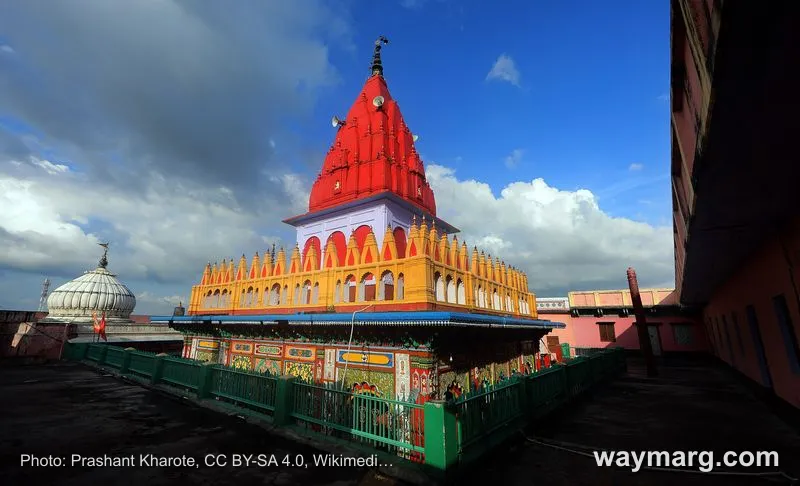
A short climb up roughly 76 steps leads to Hanuman Garhi, a fortress-like hilltop shrine -- its thick, bastion-like outer walls look more like a small fort than a temple, which is close to the point. Tradition holds that after Rama's return from Lanka, Hanuman asked to settle permanently in Ayodhya to keep watch over Ramkot, the citadel area that includes Rama's own birthplace, rather than return to his forest home -- and this hill, overlooking the city and the Sarayu beyond, is where he's said to have taken up residence. The temple's own telling traces its line back to legend, crediting the semi-mythical king Vikramaditya with an original shrine on the site roughly two thousand years ago; what stands there today is considerably younger. Historical accounts place a serious rebuilding in the 18th century under the Bairagi (Ramanandi) ascetics, who are said to have taken the site back from Mughal-era control, and in 1855 the Nawab of Awadh granted land revenue that funded the temple's construction into its present form -- putting the building pilgrims climb to today at roughly 170 years old, even as the site's own sacred claim runs back millennia. It's one of the city's most visited sites independent of the Ram Mandir crowds, run today by Bairagi Mahants of the Nirvani Akhara, and the view from the top -- over Ayodhya's rooftops and the Sarayu beyond -- is worth the climb on its own.
Kanak Bhawan: A Queen's Wedding Gift
Kanak Bhawan, the "golden palace," is tradition's answer to a quieter question: where did Rama and Sita actually live after their wedding, before any of the Ramayana's exile and war had even begun? The temple's own telling holds that Kaikeyi -- Dasharatha's second queen, and the same Kaikeyi who later insists on Rama's fourteen-year exile -- gifted this palace to Sita as a wedding present, in better days before that rupture. Layers of legend attach still-older rebuilds to this site -- Rama's son Kush, the kings Rishabh Dev and Vikramaditya, and a construction credited to the Gupta-era king Samudragupta are all named in local tradition -- but the structure pilgrims actually walk through today has a firm, documented date: it was rebuilt in 1891 by Maharaj Mahendra Pratap Singh of Tikamgarh/Orchha and his queen, Maharani Vrishabhan Kunwari, who is credited as the driving force behind the project and who installed the largest of the temple's three enshrined pairs of Rama-Sita idols (a second, older pair is said to have been protected by Vikramaditya centuries earlier, and a third was reportedly unearthed while digging the 1891 foundation). The building's palace-like domes and arches echo Rajasthani and Bundelkhand architecture rather than standard North Indian temple form -- a visible clue to its royal, residential origin story. It makes for a noticeably more intimate atmosphere inside than either the Ram Mandir or Hanuman Garhi.
The Sarayu Ghats and Evening Aarti
Every evening, the ghats along the Sarayu river host an aarti that, while smaller in scale than Varanasi's Ganga aarti, draws a steady local and pilgrim crowd for the same reason: the simple theatre of lamps on moving water at dusk. Ram ki Paidi, the most prominent ghat stretch and the site of Ayodhya's annual Deepotsav lamp festival around Diwali, is the easiest to find and the most active after sunset, with the aarti typically running from around 5 to 6 PM -- shifting earlier in winter and later in summer with sunset itself. The ghat area is open around the clock, so an early-morning visit before the crowds arrive is its own, quieter experience.
Visiting Today
The Ram Mandir runs on a split schedule: morning darshan from roughly 7 AM to 11:30 AM, a midday closure, and afternoon darshan from about 2 PM to 7 PM, with a separate pre-dawn Shringar Aarti around 6:30 AM, a midday Bhog Aarti, and an evening Sandhya Aarti -- aarti attendance generally needs a pass arranged through the Shri Ram Janmbhoomi Teerth Kshetra Trust. Phones and cameras are not allowed inside the garbha griha (inner sanctum) and must be deposited at a free locker counter beforehand; leather items such as belts and wallets should also be left behind before the inner sanctum. Dress modestly -- cotton clothing is genuinely more comfortable given the queue lengths, and shorts or sleeveless tops are discouraged.
Hanuman Garhi keeps notably longer hours: open roughly 5 AM to 10 PM, with morning aarti and darshan from about 5:30 to 11 AM and evening darshan picking back up from about 4 PM onward, extended further on festival days. Entry is free and no locker formalities apply, though the steps can get slippery during the monsoon months. Kanak Bhawan generally follows a similar two-shift pattern common to Ayodhya's smaller temples -- open through the morning, a midday closure, and open again into the evening -- and, being a working, unticketed shrine rather than a monument, is best checked for that day's exact hours on arrival rather than planned against a fixed schedule from home.
When to Go
Ram Navami (Rama's birthday, in the Hindu month of Chaitra, usually March or April) is the single heaviest day of the year across every site in this guide, with reported footfall at the Ram Mandir alone running well past a lakh of visitors; Hanuman Jayanti and the Diwali week (when Ram ki Paidi hosts Deepotsav) are a close second and third. Outside those dates, the Ram Mandir's quietest day is reportedly Tuesday, with Wednesday and Thursday moderate and the weekend-into-Monday stretch busiest; the worst hours anywhere in the city tend to be late morning, from about 11 AM to 2 PM, once both the heat and the day's peak arrivals land together. Arriving for the first darshan slot, or catching the Sarayu aarti instead of fighting the temple queue at the same hour, are both reasonable ways around the crowd.
Getting There
Ayodhya has its own airport, Maharishi Valmiki International Airport, and a well-served railway junction, making it an easy solo stop. It also pairs naturally into the wider Uttar Pradesh pilgrimage circuit: Varanasi is about 200 km east, roughly a 3-hour drive or a comparable train journey, and Prayagraj (Allahabad) is closer still, about 165 km southwest, around 2.5 hours by road -- making an Ayodhya-Prayagraj-Varanasi loop, or the reverse, one of the more efficient multi-city pilgrimage routes in the state. All four sites in this guide -- Ram Mandir, Hanuman Garhi, Kanak Bhawan, and the Sarayu ghats -- sit within a few kilometres of each other inside Ayodhya itself and are easily covered on foot or by cycle-rickshaw; a practical loop runs Ram Mandir in the morning to beat both the heat and the queues, Hanuman Garhi and Kanak Bhawan through the rest of the day, and the Sarayu ghats at dusk for the aarti.
Ready to plan your trip?
Build a day-by-day itinerary with WayMarg — explore routes, nearby food and stays, collaborate with family, and export your trip. No sign-up needed.
Plan My Trip →